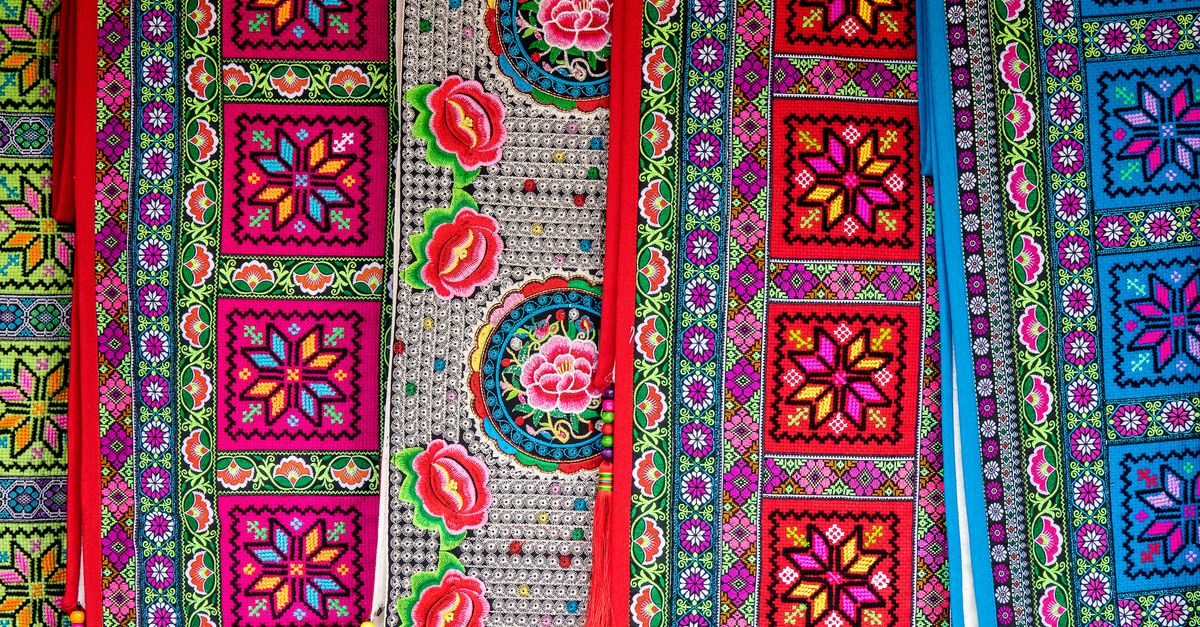
The Quilt That Started a Conversation
Somewhere between the first panel and the last, most visitors slow down. They stop reading the placards and simply look — at the riot of jewel-toned silk, the asymmetrical bursts of embroidery, the fan shapes and spiderweb motifs that tumble across fabric surfaces like fever dreams rendered in thread. The Crazy Quilt Show at Chestnut Square Heritage Village has that effect on people, even those who arrived with no particular interest in needlework.
Housed inside the Church Street Auditorium at 306 Church St. in McKinney, the exhibition is doing something quietly remarkable this summer: it is presenting one of the largest collections of Crazy Quilts in the entire country, drawing together pieces crafted between the 1870s and the 1920s, and inviting a contemporary audience to spend time with objects that have not been ordinary household goods for more than a century.
The show runs through June, which means there are still weeks left for McKinney residents — and the visitors who have been flowing into the city this summer — to walk through those doors on Church Street and encounter something genuinely difficult to find anywhere else.
What a Crazy Quilt Actually Is
The name is slightly misleading. These quilts are not chaotic. They are, in their own way, obsessively disciplined — but they reject the orderly repeating geometry that most people picture when they think of American quilts. Where a traditional patchwork quilt organizes its fabric into predictable squares or triangles, a Crazy Quilt fragments the surface into irregular, interlocking shapes: a narrow sliver of velvet beside a wide trapezoid of silk brocade beside a small rhombus of satin, each seam covered with decorative embroidery stitches in contrasting colors.
The style emerged in the late nineteenth century as a kind of fashionable domestic art, influenced partly by the asymmetrical compositions of Japanese decorative objects that flooded Western markets after trade opened with Japan in the 1850s. By the 1880s, making Crazy Quilts had become a widespread passion among American women with access to fine fabrics — and sometimes among those who could only afford to work with scraps salvaged from worn-out clothes and household linens.
What that means, practically, is that every quilt in the Church Street Auditorium is a historical document. The fabrics record what was being manufactured and sold in a given decade. The embroidered motifs — birds, flowers, fans, spiders, horseshoes, faces — reflect the visual culture and personal preoccupations of the women who made them. The choice of which commemorative ribbon to incorporate, which scrap of a child’s dress to preserve, which corner to sign with initials and a date, tells fragments of individual biography that no other source has recorded.
Why McKinney Is the Right Place for This
Chestnut Square is not a newcomer to this kind of stewardship. The heritage village at 315 S. Chestnut Street has spent decades preserving and interpreting the material history of McKinney and Collin County, maintaining a collection of historic structures and hosting programs that connect present-day residents with the craft traditions, domestic lives, and community rhythms of earlier generations.
McKinney’s historic downtown, with its nineteenth-century commercial buildings still standing along the square, provides a physical context that makes the quilts feel less like artifacts behind glass and more like objects that belong to a continuum. The women who made Crazy Quilts in the 1880s and 1890s lived in towns that looked, in many respects, like the streets that still surround the Church Street Auditorium today. That architectural continuity is not incidental. It is part of what makes a visit to the show feel different from a trip to a large urban museum.
The timing matters too. McKinney has been drawing unusual attention this summer, with the FIFA World Cup bringing international visitors through North Texas and the city’s own programming encouraging people to linger and explore beyond whatever event brought them here in the first place. A person who comes to McKinney for a match viewing or a downtown festival and wanders into the Crazy Quilt Show is likely to leave with a considerably more layered impression of the city than they arrived with.
Color, Creativity, Love, and History
Those four words — color, creativity, love, and history — appear in how Chestnut Square describes what visitors will find stitched into the quilts on display, and they are worth sitting with individually.
Color is the first thing you notice. Crazy Quilts were made to be visually striking, and the combination of silk, velvet, and satin in deep Victorian palettes — burgundy, forest green, royal blue, gold, black — produces an intensity that holds up across more than a century. These are not faded relics. Many of them look as though they could have been finished last year.
Creativity is what distinguishes one quilt from another. Because the form has no required pattern, each maker solved the compositional problem of the surface in her own way. Some quilts feel dense and almost overwhelmed with imagery. Others achieve something close to elegance through restraint. Looking at several dozen examples in a single room makes the range of individual artistic decisions visible in a way that no single quilt can demonstrate on its own.
Love is the word that tends to surface when people start reading the embroidered inscriptions and recognizing the commemorative fabrics. A piece of ribbon from a political campaign, a scrap of a wedding dress, a child’s initials worked in silk floss — these are the gestures of people who made objects not just to cover beds but to hold memory in physical form.
History, finally, is what the collection as a whole provides. Fifty years of American textile production, domestic labor, popular imagery, and women’s creative life are documented across these quilts in ways that complement and sometimes contradict the official historical record.
Making Time for Church Street This Month
For McKinney residents who have been meaning to get over to the Church Street Auditorium and simply have not made it yet, the window is still open — but it will not stay open indefinitely. The show runs through June, and given the density of summer programming happening across the city, it is easy for a stationary exhibition to drift off the mental calendar.
There is also something to be said for the particular quality of attention that a textile exhibition rewards. Unlike a concert or a festival, the Crazy Quilt Show operates at a pace the visitor controls entirely. You can spend three minutes or three hours. You can focus on one detail — a single embroidered spider crouching in the corner of a quilt made sometime around 1890 — or step back and take in the visual effect of an entire wall covered in Victorian needlework.
Chestnut Square also has an event scheduled for June 11, offering another reason to make the trip to the south end of downtown McKinney in the coming days and pair a visit to the auditorium with whatever else is happening on the grounds.
The quilts will not be here forever. The women who made them are long gone, and the domestic world that produced this particular art form has not existed for generations. But on Church Street in McKinney this summer, the work survives — vivid, intricate, and patient, waiting for the next person who decides to slow down and look.