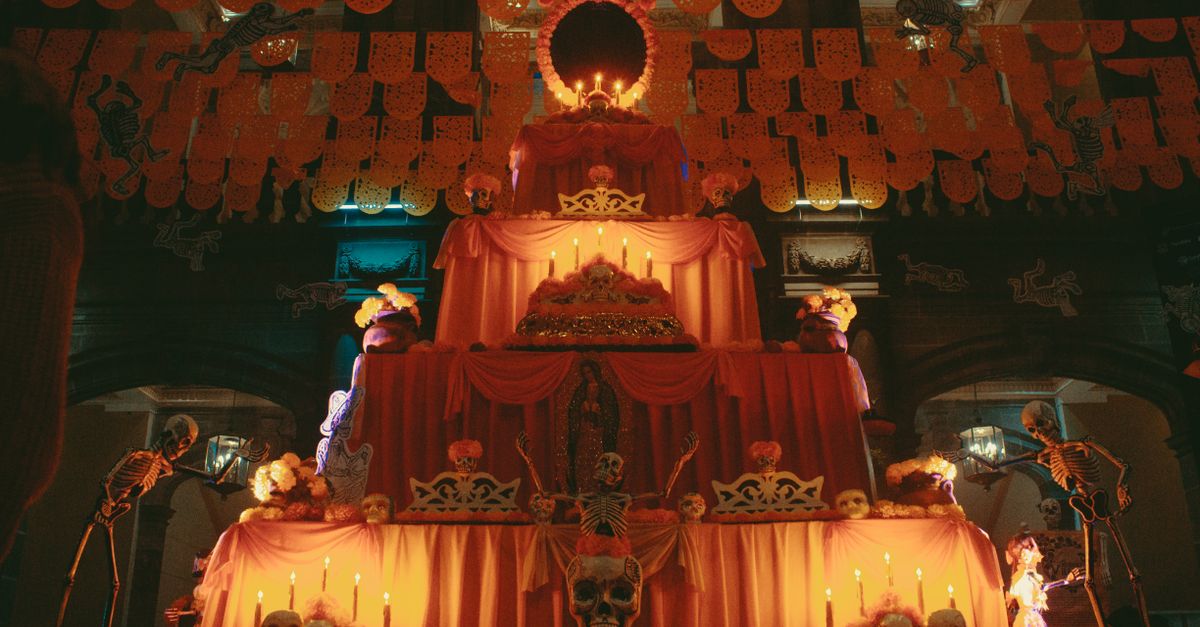
Where the Marigolds Lead
There is a particular quality of light on an October evening in McKinney — the sun dropping behind the rooftops of the historic downtown district just long enough to turn everything amber before the twinkle lights take over. On October 17, 2026, that light will land on marigold petals, painted faces, and hand-stitched papel picado strung across the outdoor grounds of TUPPS Brewery at 402 E. Louisiana Street. The McKinney Día de los Muertos Festival arrives this year carrying something it has always carried: the weight of memory, and the brightness of celebration.
Día de los Muertos — the Day of the Dead — is not a Mexican version of Halloween, though the two share a calendar proximity that sometimes causes confusion. Where Halloween leans into fright and anonymity, Día de los Muertos leans into recognition. It is a tradition rooted in the belief that the dead are not truly gone, that love is a bridge between worlds, and that the proper response to loss is not silence but music, color, food, and the spoken names of those who came before. In McKinney, a city that has grown rapidly and diversely over the past two decades, a festival built around those values means something specific.
A Celebration Rooted in McKinney’s Community
McKinney’s Hispanic community has been woven into the fabric of this city long before the population surge that brought national attention to Collin County. The Día de los Muertos Festival reflects that history — not as a performance for outside observers, but as a genuine community expression that has found a home in one of McKinney’s most distinctive venues.
TUPPS Brewery, which occupies a converted industrial space on East Louisiana Street, has become one of the city’s most versatile cultural anchors. On a given weekend it might host a classic car show, a movie night on the lawn, or a live music series. But the Día de los Muertos Festival asks something different of the space. It asks it to hold art installations, traditional music, and the kind of communal gathering that turns a brewery courtyard into a town square.
The October 17 festival will feature music and art woven throughout the grounds, drawing on the visual language of the holiday — ofrendas, the altar-like displays that hold photographs and mementos of the departed; intricate sugar skull imagery; and the marigold, or cempasúchil, whose scent is said to guide the spirits home. For families who have kept these traditions in their own living rooms and front porches, seeing them reflected on a public scale in their own city carries a particular kind of meaning.
The Scholarship at the Heart of It
What distinguishes McKinney’s Día de los Muertos Festival from a purely aesthetic celebration is a program that turns cultural pride into concrete opportunity. The festival includes a scholarship program sponsored by McDonald’s of North Texas, directed specifically at McKinney students pursuing higher education.
The pairing is deliberate and worth sitting with. Día de los Muertos is, at its core, a celebration of continuity — of honoring those who came before so that what they built might carry forward. A scholarship program fits that ethos precisely. It says: we remember the generations who worked to establish this community here, and we invest in the generation that will carry it further.
For McKinney students who come from Hispanic families, attending a festival where their cultural heritage is not just acknowledged but centered — and where that acknowledgment is directly linked to their academic futures — creates a different relationship with the city they live in. It signals belonging in a way that a proclamation or a heritage month display rarely can.
The details of the scholarship application process and eligibility are best confirmed through the festival’s official channels, but its presence as a core element of the event rather than an afterthought speaks to how the organizers understand the festival’s purpose.
Why October 17 Matters This Year
McKinney in October 2026 is a city in the middle of a cultural moment. The month is dense with public events — farmers markets, outdoor film screenings, a renovated downtown library preparing to reopen, and multiple festivals pulling residents out of their homes and into shared spaces. It is easy, in a city that has grown as fast as McKinney has, for different communities to occupy the same geography without ever actually meeting.
Festivals like Día de los Muertos do something that urban planning documents and city council resolutions cannot: they create conditions for encounter. A family from one of McKinney’s newer subdivisions, drawn in by the music or the visual spectacle, stands next to a family for whom this holiday is ancestral. Children in painted faces eat pan de muerto next to children who have never seen it before. Someone asks a question. Someone explains. A small thing happens that a city cannot manufacture on demand.
TUPPS Brewery’s location on East Louisiana Street places the festival within walking distance of McKinney’s historic downtown grid, in a part of the city that has itself undergone significant change while retaining an industrial texture that suits a festival of this kind. The space is large enough to hold the event’s ambitions without losing the intimacy that makes Día de los Muertos meaningful.
Preparing for the Day
The festival runs on October 17, 2026. Visitors planning to attend will find the full event details, including any ticketing information, vendor lineup, and scholarship program specifics, at the festival’s official site. Given the volume of events happening across McKinney that weekend — the Trick or Treat Trail at Towne Lake Park runs the same afternoon, and Halloween at the Heard begins that evening at the Heard Natural Science Museum and Wildlife Sanctuary — it is worth arriving with a sense of how much time you want to spend.
For those new to Día de los Muertos, the best preparation is simply curiosity. The holiday rewards attention. The details in an ofrenda — the specific photograph chosen, the food left out, the handwritten note — are not decoration. They are biography. Every element has a reason. Taking time to look, and perhaps to ask, is the whole point.
What a Festival Carries
McKinney has a habit of honoring its own history. The Cotton Mill still stands on Elm Street. Chestnut Square preserves the bones of the city’s 19th-century identity. The downtown square has been maintained as a civic gathering place through every phase of the city’s growth. There is something in the civic character here that understands the value of keeping things — of not erasing what came before in the rush toward what comes next.
Día de los Muertos, as a tradition, shares that instinct. It insists that the past is present, that the people who shaped a place do not disappear when they leave it, and that remembering them is not grief but gratitude. In a city that is still, in many ways, figuring out who it is becoming, a festival built on that philosophy offers something useful: a reminder that becoming does not require forgetting.